

A country average is the most quoted number in this trade and the least useful one. It gets used because it costs nothing to produce and it sounds like a fact about price, and there is no shortage of data behind it: Peru imported $1,784 million of tyres in the window.
Take the two origins everyone compares. Averaged over every kind of tyre, and over shipments from January 2025 to date, the median Chinese one lands in Peru at $33 and the median Indian one at $109. Median meaning half the shipments come in under that figure, which matters here more than usual, because the average is dragged around by a handful of enormous tyres. Read as price, that says India costs three times as much and has no business competing here.
The picture changes as soon as the product is held still. A tyre is not one product, and the customs code already splits it into kinds: car, truck and bus, motorcycle, bicycle, agricultural, mining and construction. Inside truck and bus, China lands at $68.49 and India at $69.60, a dollar and eleven cents apart on a tyre that costs seventy. Inside mining and construction, China runs around $250 and India around $197. Inside agricultural, China is around $208 and India around $160.
In the two families where a tyre costs hundreds, India is the cheaper of the two.
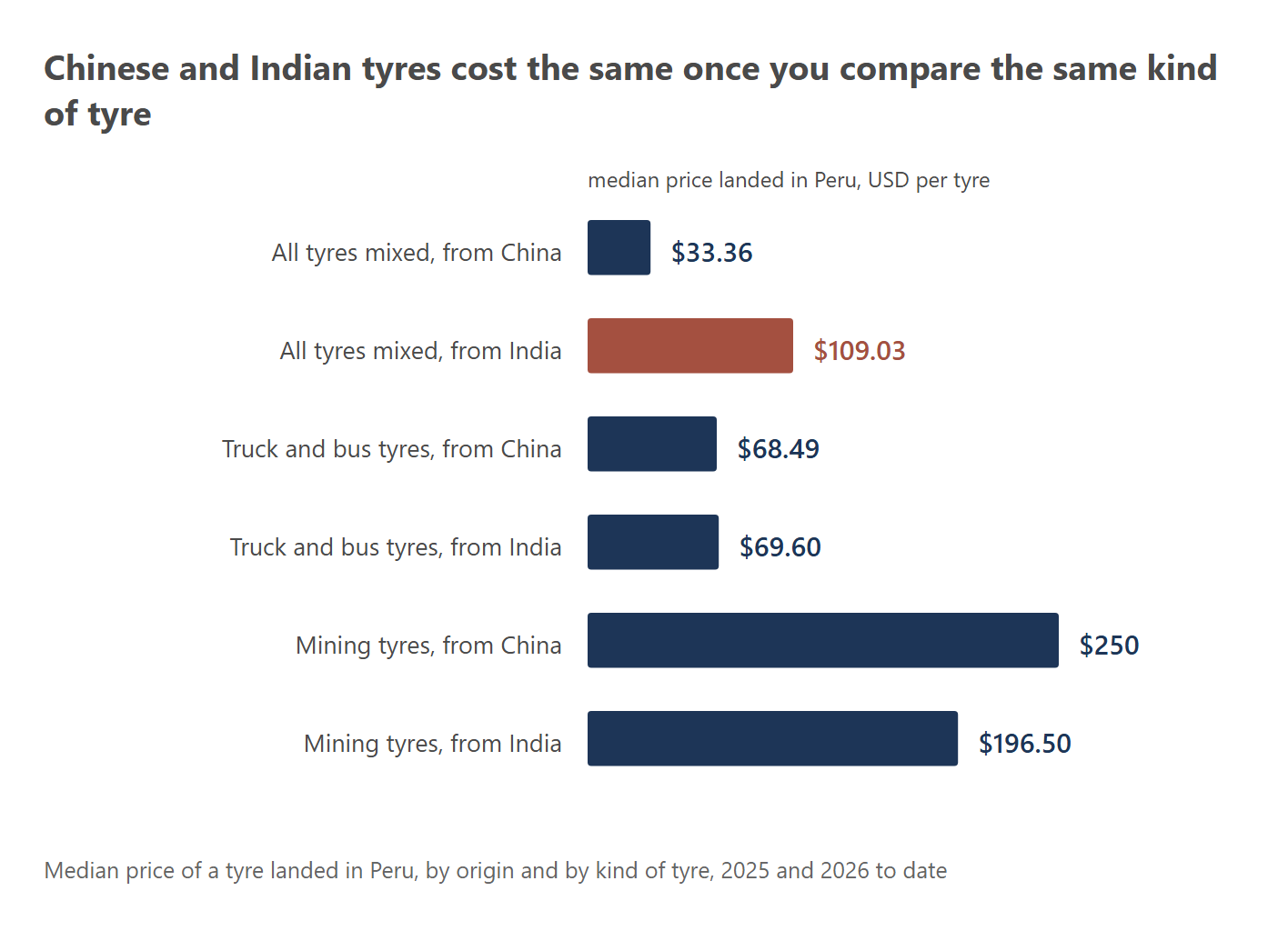
The headline gap turns out to be a difference of catalogue. China lands about 2.5 million car tyres and 2.6 million motorcycle tyres into Peru in the window, both cheap by the piece, with the median motorcycle tyre at $11.50. India barely ships a car tyre at all and concentrates in agricultural and mining sizes, where one tyre runs around $250, which is about twenty of those motorcycle tyres. An average built on two catalogues that far apart describes neither of them.
The same table answers a second question that gets asked more often than it gets checked, which is where the money in this market actually sits. Motorcycle tyres are 36.3% of every piece that crosses the border and 8.6% of the value. Truck and bus is 30.7% of the pieces and 55.8% of the value. Mining and construction is 1.4% of the pieces and 12.8% of the value, or nine times its weight in pieces.
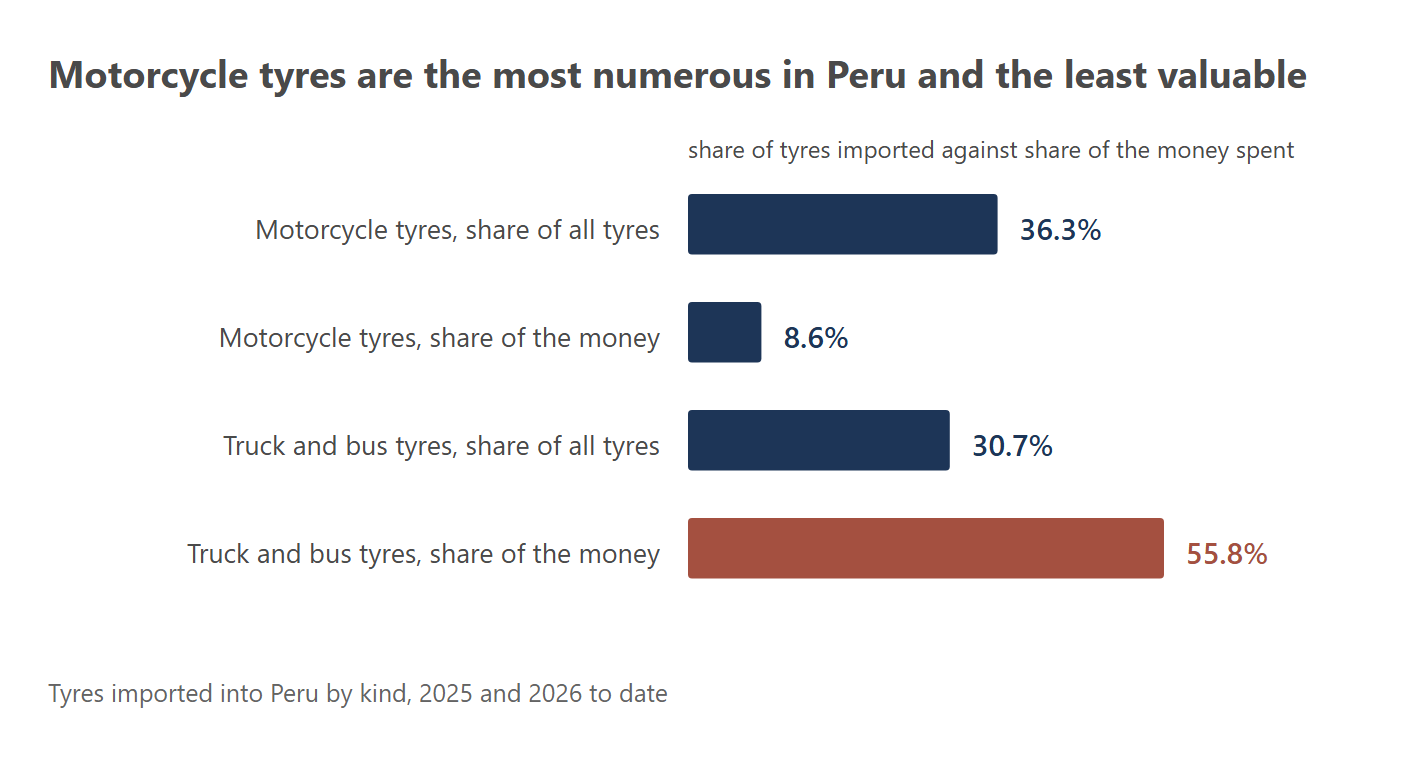
A sales plan built on unit volume points at motorcycles, and a plan built on value points at truck, bus and mining sizes. The two plans call on different importers, quote different measurements and need different stock, so the choice between them is made long before anyone talks about price.
There is a limit worth naming before anyone acts on this. Prices here are read per piece, which is how the customs tariff counts tyres and how the trade press quotes them, and that covers around 60% of the value directly. Close to another 30% arrives declared in sets, which still counts pieces but in fours, so a set price cannot be laid beside a single price without dividing first.
Read the same data per kilo and it tells a cleaner and completely different story, which is a good reason to distrust it. By weight the United States looked like a premium origin at $8.16 a kilo. By the piece it drops out of the top eight, because weight measures the size of a tyre and price measures what it does.
There is a plausible mechanism behind the whole pattern, though the record alone does not prove it. Sizes get made where the domestic fleet demands them. India runs an enormous agricultural and commercial fleet and China runs an enormous passenger and two wheeler one, and each exports what its own factories were built to make.
Whatever the cause, the practical consequence is the same for anyone selling into Peru. Which family the buyer works in settles the origin question: China is the cheaper origin in car and motorcycle sizes, India in mining and agricultural ones. An importer of mining tyres who is told that Chinese product costs a third of the Indian one has been handed a number from the motorcycle aisle, when in their own aisle the Chinese tyre is the dearer of the two by about $50.