

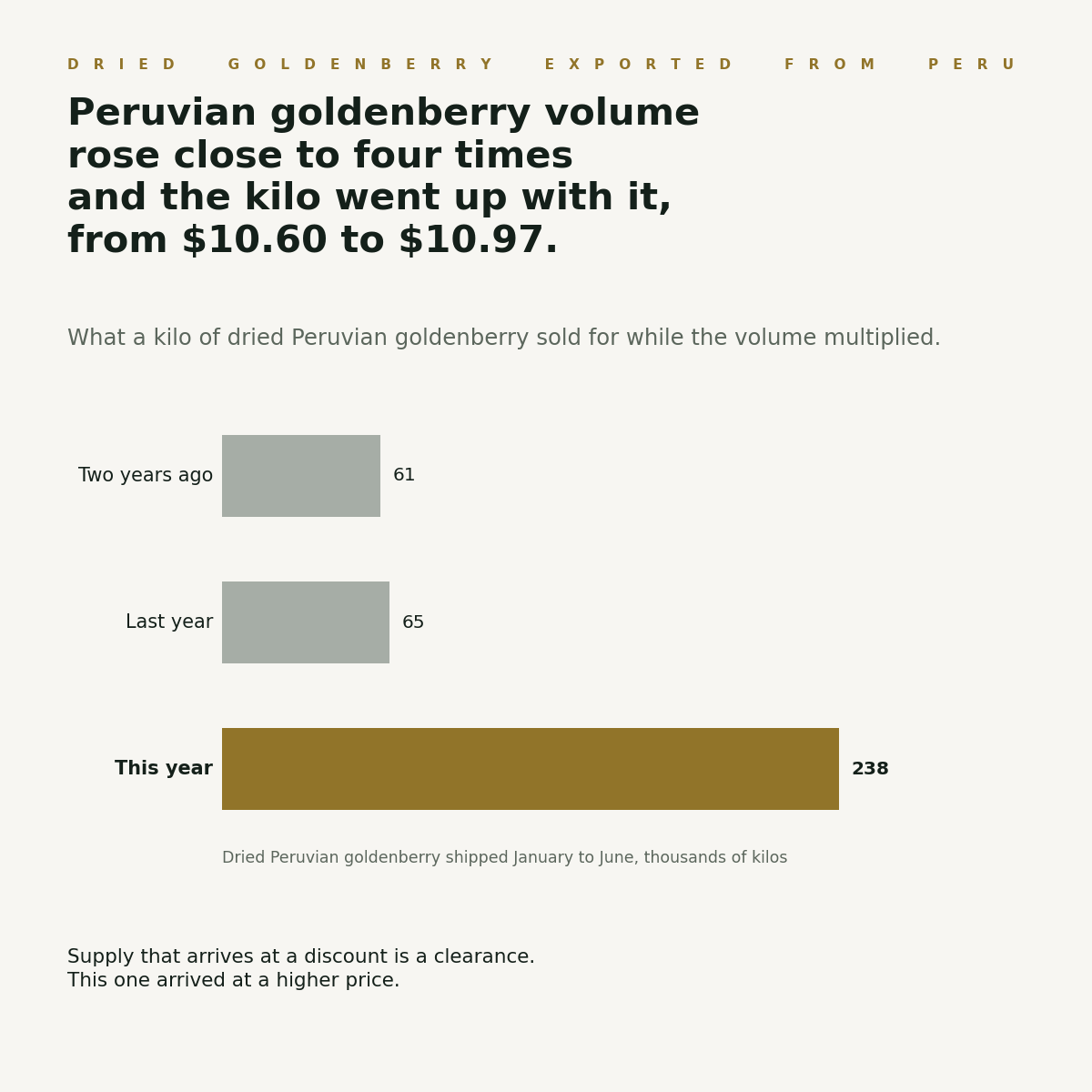
Through June this year, Peru shipped 238,303 kilos of goldenberry.
Over the same January to June of 2025 it shipped 64,648, and January to June of the year before came in at much the same level. The base it jumped from was flat, so this is close to four times over rather than a rebound.
The number that makes it worth reading is the price. The kilo in the middle moved from $10.60 to $10.97, comparing January to June against January to June. Supply that arrives because somebody is clearing inventory takes the price down with it. This price went up by about 3%.
Volume and price usually move against each other. Most sourcing teams read a supply jump as a discount signal and wait for the break. Here the two moved the same way. That points at demand arriving alongside the supply rather than ahead of a glut. It is the difference between a market where a buyer should wait and one where a buyer should get onto quote lists before the good exporters are committed.
The other thing worth checking on any growth number is whether it belongs to a single company. A fourfold jump driven by a single exporter winning one contract would say little about a buyer's own chances of being served.
Here it belongs to several. Two exporters multiplied their shipped volume by roughly five and seven times.
A third grew by nearly three. A fourth appeared at scale in the first stretch of this year after shipping none over those same months a year earlier.
The steadiest of the large exporters barely moved at all, which carries its own signal: the growth came from exporters building capacity rather than from the incumbent leader expanding. Nineteen exporters shipped between January and June, against fourteen a year earlier.
Germany took the most volume, ahead of Italy, the United States, the Netherlands and Australia. That ordering is worth flagging because it changes with the months you count. Measured over all three years, the United States leads. Measured on this year so far, Germany does, by a wide margin and across six different exporters. European demand is where the new volume landed.
Prices across those destinations sit within about a dollar of each other. No market is paying a premium worth routing around, which simplifies the decision: destination is a logistics question here rather than a pricing one.
June is only halfway, and a harvest does not spread evenly across six months. Comparing the same stretch of each year controls for the seasonality, and it does not settle the rest of the year. If the crop came early this year, part of the jump is timing rather than volume.
There is also a scope judgement. Goldenberry sits inside a broader dried fruit code, so these figures come from filtering shipments by what the description actually says: aguaymanto, goldenberry, physalis, uchuva. That filter keeps about 70% of the code's value and leaves the rest, which is other fruit entirely. A shipment described in a way none of those words catch sits outside these numbers.
A buyer who priced this category as thin, expensive and effectively single-source has a different situation this year. There are more exporters to put on a quote list than there were, several with fresh capacity and no long-standing exclusive relationships to protect. The ones that grew did it without discounting, so they are unlikely to compete on price alone, and they are not distressed either.
The window to build a second and a third exporter here is open while the new capacity is still looking for homes, and a quote list drawn up now costs nothing to hold.
Peru Sourcing Partners follows what leaves Peru and who ships it.